
A career in data analytics offers strong demand, competitive pay, and opportunities across nearly every industry. This Data Analyst Career Guide explains what data analysts do, how to start, the skills you need, and how to advance from entry-level roles into senior and leadership positions.
If you’re exploring this field in depth, you may also find the data analyst career guide useful for understanding long-term growth, role expectations, and industry trends.
Whether you’re new to data or looking to grow your analytics career, this guide provides a clear, step-by-step path.
Reviewed by senior career experts at Vocationic, led by Sarah Johnson, Senior Career Coach.
What Does a Data Analyst Do?
Data analysts collect, clean, analyze, and interpret data to help organizations make better decisions. Their work transforms raw data into actionable insights that support business strategy, operations, and performance improvement.

Common responsibilities include:
- Collecting and organizing structured and unstructured data
- Cleaning and validating datasets for accuracy
- Analyzing trends, patterns, and relationships
- Creating reports, dashboards, and visualizations
- Communicating insights to stakeholders
Data analysts work closely with business teams, engineers, and leadership to ensure data-driven decision-making.
Data Analyst Career Path Overview
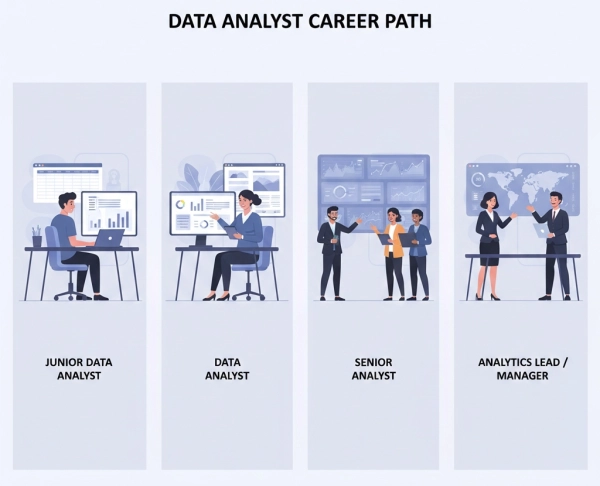
While job titles vary, most data analyst careers follow a similar progression based on experience, technical depth, and business impact.
A typical data analyst career path includes:
- Junior or Entry-Level Data Analyst
- Data Analyst
- Senior Data Analyst
- Lead Data Analyst or Analytics Manager
- Specialized or advanced roles (Data Scientist, Analytics Engineer)
Not all analysts move into management—many choose deep technical or domain-specific paths.
Entry-Level Data Analyst Roles
Junior Data Analyst / Data Analyst I
Role Overview
Entry-level data analysts are at the beginning of their analytics careers. Their focus is on learning how data flows through an organization, understanding business metrics, and building technical foundations.
Junior analysts typically support reporting, work with structured datasets, and follow established analytical processes. Candidates preparing for these roles often review data analyst resume examples to understand how employers evaluate entry-level experience.
Key Responsibilities
Common responsibilities at this stage include:
- Cleaning, organizing, and preparing raw data for analysis
- Writing basic SQL queries to extract and filter data
- Creating recurring reports and dashboards for stakeholders
- Validating data accuracy and identifying inconsistencies
- Documenting data definitions, metrics, and analysis processes
- Supporting ad hoc analysis requests from senior analysts or managers
Accuracy and attention to detail are critical, as entry-level analysts often work with foundational datasets that others rely on.
Skills to Develop
To succeed and grow quickly, junior data analysts should focus on:
- SQL fundamentals (SELECT statements, joins, filtering, aggregation)
- Spreadsheet analysis using Excel or Google Sheets
- Basic data visualization principles and charting techniques
- Analytical thinking and problem-solving
- Data hygiene and quality control
- Clear written and verbal communication
Learning how to frame the right business questions is just as important as technical execution. Building these capabilities early also helps when tailoring your resume—see great skills to have on a resume for guidance.
Typical Experience
- 0–2 years of professional experience
- Internships, academic projects, or personal data projects are often accepted

Mid-Level Data Analyst
Data Analyst
Role Overview
Mid-level data analysts work more independently and are responsible for delivering insights that directly influence business strategy. They move beyond routine reporting and begin solving open-ended problems using data.
At this stage, analysts are expected to understand business context, define metrics, and translate data into clear recommendations for stakeholders.
Key Responsibilities
Mid-level data analysts typically handle:
- Designing and executing end-to-end data analyses
- Building interactive dashboards and performance reports
- Identifying trends, risks, and opportunities within datasets
- Partnering with stakeholders to define data requirements
- Supporting decision-making with data-driven insights
- Improving reporting processes and analytical workflows
They often act as a bridge between technical data teams and non-technical business users.
Skills to Build
To perform effectively at this level, analysts should strengthen:
- Advanced SQL (subqueries, window functions, optimization)
- Data visualization tools such as Tableau, Power BI, or Looker
- Statistical analysis and hypothesis testing
- Business communication and storytelling
- Requirements gathering and stakeholder management
The ability to explain complex findings in simple, actionable terms becomes increasingly important.
Typical Experience
2–5 years of experience in data analytics or related roles

Senior-Level Data Analyst Roles
Senior Data Analyst
Role Overview
Senior data analysts are trusted experts who lead complex analyses, define analytical standards, and shape how organizations use data. Their work influences long-term strategy rather than just short-term decisions.
They are also responsible for mentoring junior analysts and improving the overall analytics maturity of the organization.
Key Responsibilities
Senior data analysts commonly focus on:
- Managing large, complex, or high-impact datasets
- Designing metrics, KPIs, and analytical frameworks
- Leading cross-functional analytics initiatives
- Ensuring data quality, consistency, and governance
- Translating insights into strategic business recommendations
- Reviewing and guiding the work of junior and mid-level analysts
Their role combines deep technical expertise with leadership and strategic thinking.
Skills to Develop
Key skills at the senior level include:
- Advanced analytics and statistical modeling
- Data modeling and metric design
- Strategic thinking and business alignment
- Leadership, mentoring, and influence
- Executive-level communication
Strong leadership skills for non-managers are often essential even before stepping into formal management roles.
Typical Experience
5+ years of experience (varies by organization and industry)
Specialized Data Analytics Career Paths
As data analysts gain experience, many choose to specialize in a specific domain to increase impact, responsibility, and earning potential.
Common Specializations Include
- Business Analyst – Focuses on business processes, KPIs, and operational performance
- Product Analyst – Analyzes user behavior, funnels, and product metrics
- Marketing Analyst – Measures campaign performance, attribution, and customer insights
- Financial Analyst (Data-Focused) – Supports forecasting, budgeting, and financial modeling
- Analytics Engineer – Builds data models and analytics layers between data engineering and BI
Specialization allows analysts to develop deep domain expertise while still leveraging core analytics skills. Understanding industry benchmarks, such as compensation trends, can also inform career decisions—see digital marketing salary guide for a related example of how specialization affects pay.
Skills Needed to Become a Successful Data Analyst
A strong data analyst combines technical ability with business understanding.
Technical Skills
SQL and relational databases
Excel or Google Sheets
Data visualization platforms
Basic statistics and probability
Python or R (optional but increasingly valuable)
Business and Soft Skills
Critical thinking and problem-solving
Clear communication and data storytelling
Stakeholder collaboration
Curiosity and attention to detail
Ability to prioritize and manage multiple requests
Many of these align with broader problem-solving skills and time management skills valued across professional roles.
Tools Commonly Used by Data Analysts
Most data analysts work with a combination of tools, including:
- Databases: PostgreSQL, MySQL, BigQuery
- Spreadsheets: Excel, Google Sheets
- Visualization: Tableau, Power BI, Looker
- Programming: Python, R
- Data warehouses and BI tools
You don’t need to master every tool—focus on transferable skills and core concepts.
Certifications and Education
While formal degrees are helpful, many data analysts come from non-traditional backgrounds.
Helpful Certifications
- Google Data Analytics Certificate
- IBM Data Analyst Professional Certificate
- Microsoft Power BI Certification
- Tableau Desktop Specialist
Certifications add value when paired with hands-on projects and real-world experience.
How to Get Started as a Data Analyst
To begin a data analyst career:
- Learn SQL, Excel, and basic statistics
- Practice with real datasets and case studies
- Build a portfolio with dashboards and documented analyses
- Apply for internships, junior analyst roles, or entry-level positions
- Continue learning through projects and online resources
Employers prioritize demonstrated skills and problem-solving ability over credentials alone.
How to Advance in the Data Analyst Career Path
To progress beyond entry-level roles:
- Take ownership of business-critical analyses
- Develop domain expertise in your industry
- Improve data storytelling and stakeholder communication
- Learn advanced analytics, automation, or programming
- Mentor others and influence data strategy
Career growth in data analytics is driven by impact, insight, and leadership, not just technical proficiency.

Key Takeaway
This Data Analyst Career Guide outlines a flexible and rewarding path for professionals interested in data-driven work. With the right skills, tools, and experience, data analysts can grow into senior, specialized, or leadership roles across industries.


Comments (0)