
A project management career offers strong job stability, competitive salaries, and opportunities across nearly every industry. Understanding the project manager career path helps you plan your education, gain the right experience, and move into leadership or specialized roles over time.
If you’re exploring this role more seriously, reviewing real-world project manager resume examples can help you understand how responsibilities, skills, and impact evolve at different career stages.
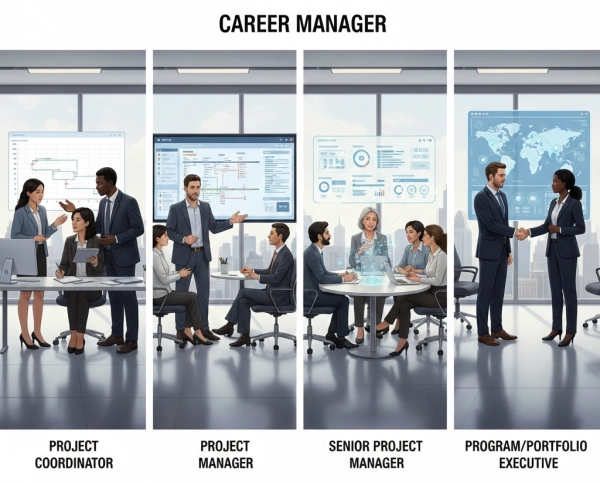
This guide explains the typical project management career progression, required skills, certifications, and how industry paths—such as the construction project manager career path—differ.
Reviewed by senior career experts at Vocationic, led by Sarah Johnson, Senior Career Coach.
Overview of the Project Manager Career Path
While job titles vary by organization, most project managers progress through similar career stages. Advancement is based on experience, leadership ability, and the complexity of projects managed.
A typical project manager career path includes:
- Project Coordinator or Assistant Project Manager
- Junior Project Manager
- Project Manager
- Senior Project Manager
- Program Manager or Portfolio Manager
- Director of Project Management or PMO
- Executive roles (Operations Director, VP, or COO)
Some project managers also specialize in technical or industry-specific paths rather than people management.
Entry-Level Project Management Roles
Entry-level project management roles are designed to help professionals build a strong foundation in planning, coordination, and communication. These positions focus on learning how projects are run, understanding stakeholder needs, and supporting delivery teams.
Project Coordinator / Assistant Project Manager
Role Overview
Project Coordinators and Assistant Project Managers provide operational support to project teams. This role is often the first step in the project manager career path and emphasizes organization, process awareness, and communication.
Many candidates entering this stage benefit from understanding how to write a resume that highlights coordination experience, internships and transferable skills.
Key Responsibilities
In this role, professionals typically handle day-to-day coordination tasks such as:
- Scheduling meetings, workshops, and project check-ins
- Tracking timelines, milestones, and task progress
- Maintaining project documentation, reports, and status updates
- Supporting budget tracking, invoices, and expense reporting
- Coordinating communication between team members, vendors, and stakeholders
Skills to Develop
At this stage, the focus is on building strong fundamentals, including:
- Time management and organizational skills
- Understanding basic project management frameworks and terminology
- Clear written and verbal communication
- Attention to detail and documentation accuracy
- Familiarity with project management software such as Jira, Asana, Trello or Microsoft Project.
These skills align closely with core resume skills employers look for in early project management roles.
Typical Experience
0–2 years

Junior to Mid-Level Project Manager Roles
As project professionals gain confidence and experience, they begin taking ownership of project components or smaller initiatives.
Junior Project Manager
Role Overview
Junior Project Managers start managing smaller projects or defined phases of larger projects under moderate supervision. This role bridges the gap between coordination and full project ownership.
Key Responsibilities
Junior Project Managers are often responsible for:
- Managing project scope, schedules, and assigned resources
- Identifying risks, issues, and dependencies early
- Tracking deliverables and ensuring deadlines are met
- Reporting project status, risks, and progress to stakeholders
- Coordinating cross-functional teams to keep work aligned
Skills to Build
To succeed at this level, professionals should strengthen:
- Risk identification and mitigation
- Budget tracking and cost awareness
- Stakeholder communication and expectation management
- Problem-solving and practical decision-making
- Accountability and ownership mindset
Using strong action verbs for resumes helps demonstrate leadership and initiative when applying for mid-level roles.
Typical Experience
2–4 years

Project Manager
Role Overview
At the Project Manager level, professionals independently lead projects from initiation to completion. They are fully accountable for project outcomes, including scope, budget, schedule and quality.
Key Responsibilities
Project Managers typically handle:
- Defining project objectives, scope, deliverables, and success metrics
- Creating and managing detailed project plans and schedules
- Allocating resources and managing budgets
- Leading project teams and resolving conflicts
- Managing stakeholder expectations and reporting progress
- Ensuring projects align with organizational and business goals
Skills Required
This stage requires a well-rounded skill set, including:
- Leadership, influence, and negotiation
- Advanced planning, execution, and prioritization
- Data-driven decision-making and performance tracking
- Client-facing and executive-level communication
- Change management and adaptability.
Optimizing your resume for applicant tracking systems is especially important at this level—see how to optimize your resume for ATS for practical guidance.
Typical Experience
3–6 years
Senior-Level Project Management Roles
Senior roles focus on complexity, scale, and strategic impact rather than just execution.
Senior Project Manager
Role Overview
Senior Project Managers lead high-impact, complex, or multi-team projects. They are often responsible for mentoring junior project managers and improving organizational project practices.
Key Responsibilities
Senior Project Managers typically:
- Manage large-scale or cross-functional initiatives
- Oversee multiple workstreams or project teams
- Coach and mentor junior project managers
- Identify process improvements and best practices
- Support leadership with planning and strategic execution
Skills to Develop
At this level, success depends on:
- Strategic and systems-level thinking
- Cross-department leadership and influence
- Advanced risk, change, and dependency management
- Executive communication and presentation skills
- Business and organizational awareness
Typical Experience
6+ years

Construction Project Manager Career Path
The construction project manager career path follows a similar progression but places greater emphasis on technical expertise, regulatory compliance, and on-site leadership.
Typical Construction Project Management Roles
- Assistant Construction Project Manager
- Construction Project Manager
- Senior Construction Project Manager
- Construction Program Manager
- Director of Construction or Construction Operations Manager
Key Responsibilities in Construction Project Management
Construction Project Managers are responsible for:
- Planning and overseeing construction schedules and budgets
- Managing contractors, subcontractors, and suppliers
- Ensuring compliance with safety standards, building codes, and regulations
- Coordinating work with architects, engineers, and inspectors
- Managing contracts, change orders, and project documentation
Required Skills
Success in construction project management requires:
- Knowledge of construction methods, materials, and workflows
- Contract administration and vendor management
- Cost estimation, scheduling, and resource planning
- Familiarity with OSHA safety standards and local regulations
- Strong on-site leadership and problem-solving skills
Many construction project managers begin their careers in engineering, construction management, architecture, or skilled trades before transitioning into project leadership roles.

Program and Portfolio Management
With advanced experience, project managers may move into roles that oversee multiple projects or entire portfolios.
Program Manager
Program Managers coordinate multiple related projects, ensuring alignment with strategic objectives and managing interdependencies across teams.
Portfolio Manager
Portfolio Managers evaluate, prioritize, and balance projects across the organization to maximize business value and resource efficiency.
These roles require strong strategic thinking, financial awareness, and executive-level communication skills.
Certifications That Support Career Growth
While not mandatory, certifications can significantly enhance credibility and career progression.
Popular project management certifications include:
- Project Management Professional (PMP)
- Certified Associate in Project Management (CAPM)
- PRINCE2
- Agile Certified Practitioner (PMI-ACP)
- Construction management certifications such as CCM or OSHA training
Certifications are most valuable when paired with real-world project experience.
Skills Needed for Long-Term Success in Project Management
Successful project managers consistently develop:
- Leadership and people management capabilities
- Clear communication and effective negotiation
- Risk assessment, mitigation, and decision-making
- Adaptability in changing environments
- Financial literacy and business understanding
These competencies align closely with great skills to have on a resume across industries.
How to Advance in the Project Manager Career Path
To move forward in the project manager career path:
- Seek opportunities to manage increasingly complex projects
- Demonstrate leadership and ownership, not just task completion
- Strengthen stakeholder and executive communication skills
- Learn both traditional (Waterfall) and Agile methodologies
- Earn relevant certifications and continue professional learning
- Understand how projects contribute to overall business outcomes
Advancement in project management is driven by measurable results, leadership impact, and the ability to deliver value at scale—not tenure alone.
Key Takeaway
The project manager career path offers flexibility, strong earning potential and opportunities across industries. Whether you pursue a general path or a specialized route like the construction project manager career path, continuous learning, leadership development, and real-world experience are the keys to long-term success.


Comments (0)